Beyond the SaaSpocalypse: Why the Agentic Era Demands a New Security Infrastructure
The SaaS model may be under pressure, but the real story is bigger: autonomous agents are here, and they require a new control plane for security and governance.
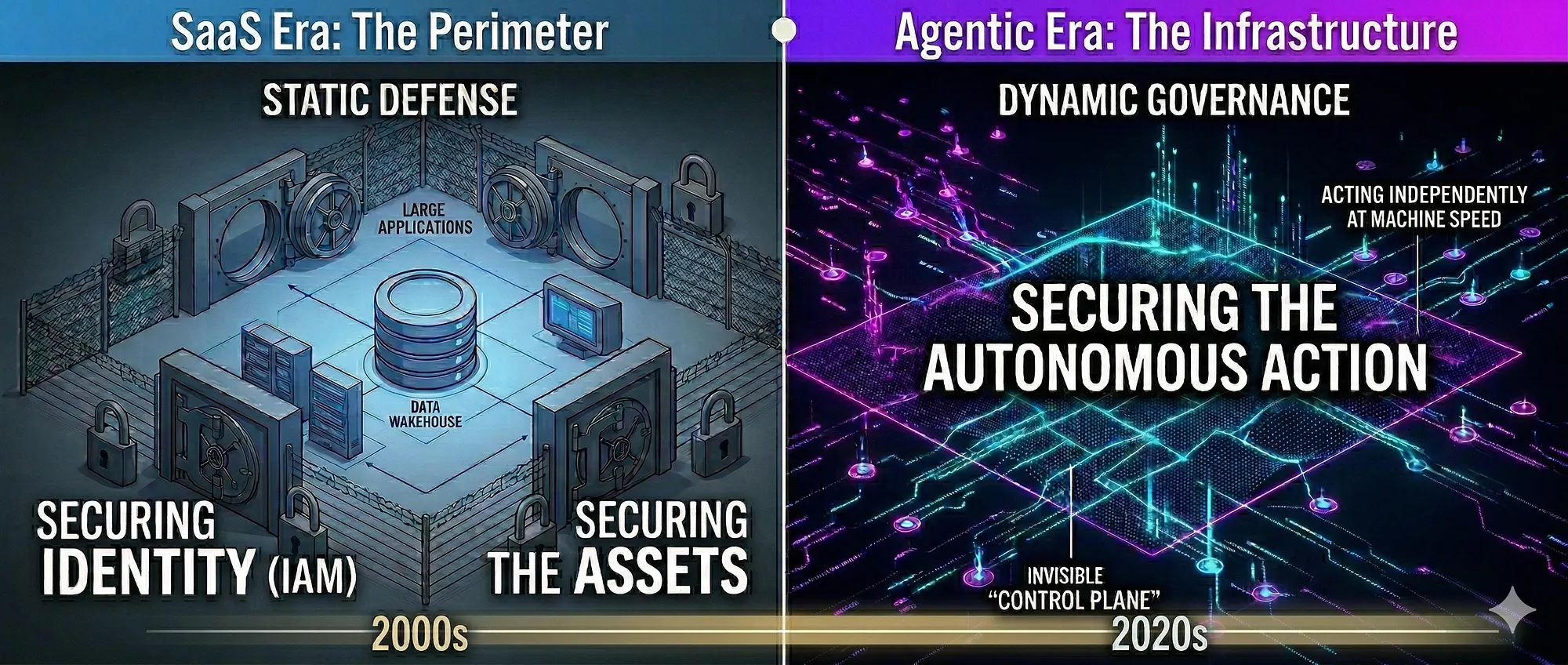
The headlines this month in tech have been nothing short of breath-taking. Between the "Treaty reports" signaling a structural shift and the massive market sell-off, the term "SaaSpocalypse" has been circulating. When Anthropic released Claude Cowork in January, it triggered a realization that the "per-seat" model we've known for decades is under siege. If AI agents can handle a wide range of tasks at machine speed, the SaaS model no longer depends on multiple users (multiple seats) — just one agent can get all the work done. Then, the February 20th launch of Claude Code Security sent a shockwave through the cybersecurity sector, erasing significant market cap in a single afternoon.
If you're watching the sea of red on the stock tickers, it's easy to feel unsettled. But we have to be honest with ourselves: this is a clear signal that the Agentic Era has arrived. Things are going to change fast — the security landscape is already shifting beneath our feet.
If you're a founder right now, especially in the security or software space, it's easy to feel the "SaaSpocalypse" breathing down your neck. You might be asking: Is what I'm building still relevant? Did a model just eat my roadmap? These are questions I have to honestly evaluate every day.
It is a reality of our field that LLMs can and will absorb features we once thought were standalone products. But at Skyrelis, the core of our evaluation is this: Markets may re-price sectors, but they do not eliminate the underlying problems. If you are solving a fundamental pain point — one that persists even as the models get smarter — then your mission is more relevant today.
The Two Faces of the AI Security Shift
To understand why the market is reacting with such volatility, we have to distinguish between two very different technological shifts that are currently being grouped together.
AI for Security (The Disrupter)
This is what Claude Code Security represents. It is an AI model performing a security task — in this case, scanning and patching code with human-like reasoning. While the market sees this as a threat to established "scanners," it is helpful to view this as a powerful new feature. It makes the foundation of our software stronger, and it is a tool every developer should have in their belt.
Security for AI (The Enabler)
This is the domain of Skyrelis. As Claude Cowork makes it easier for enterprises to build thousands of autonomous agents, the surface area of risk doesn't shrink; it explodes. These agents aren't just "tools"; they are digital employees operating at machine speed.
The "SaaSpocalypse" highlights a massive transition: the more capable AI agents become, the more "Agentic Applications" will be built in-house. And every single one of those applications requires a new kind of security architecture.
Why "Built-in" Features Are Not a Total Solution
There is a common fallacy that because a model can find its own bugs or offer self-check guardrails, we no longer need a security "solution." That's like saying because a car has an automatic braking system, we no longer need traffic lights, speed limits, or insurance.
Every agentic application will — and should — have security features built-in. But relying solely on these siloed features creates a Governance Nightmare. You cannot manage a fleet of 500 autonomous agents if each one has its own isolated security logic. Security teams don't just need agents that are "secure by design"; they need an Infrastructure Layer ready to monitor, govern, and stop them at machine speed when they deviate from their intent.
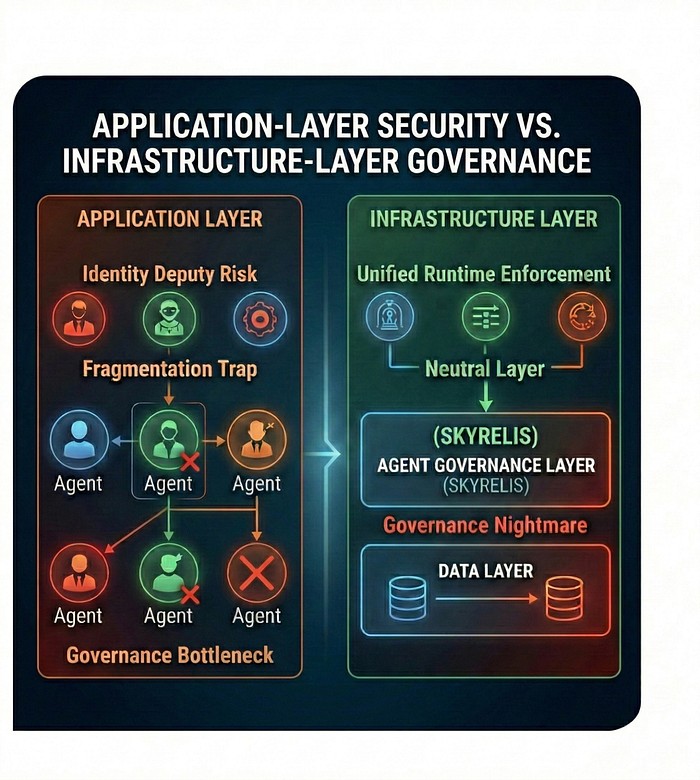
Application-Layer Security vs. Infrastructure-Layer Governance
Moving to the Infrastructure Layer: Securing the Action
In the traditional software world, we focused on securing the Identity and the Asset. We've spent decades perfecting this. But in the agentic world, the risk profile changes. When an agent acts on your behalf, we must secure the Autonomous Action.
Skyrelis focuses on the Infrastructure Layer because machine-speed requires run-time monitoring and enforcement. If you rely solely on security features built into the application layer via SDKs or model-level "judges," you face three structural risks:
- The Identity Deputy Risk: An agent is a "Super-Privileged Deputy." It carries the credentials of the user but operates with the autonomy of software. If its internal security fails — or is bypassed via prompt injection — the agent still holds the keys to your kingdom. A "self-policing" agent is a single point of failure.
- The Fragmentation Trap: An enterprise doesn't run one agent; it runs hundreds. If every agent uses its own proprietary security features, the CISO loses unified visibility. You end up with a collection of black boxes.
- The Governance Bottleneck: While SDKs offer low latency, they require an application change every time you update a policy. In a world of machine-speed agents, you can't wait for a deployment cycle to block a new threat. You need a neutral layer that enforces policies across all agents instantly.
Imagine a "Legal Agent" that suddenly starts querying a "Payroll Database" at 3:00 AM. You don't want to rely on that agent's own internal logic to decide if the query is ethical. You need a neutral Infrastructure Policy that sits between the agent and the data — one that recognizes the violation and kills the process before the data ever leaves the environment.
A Message to the Market: Focus on the Architecture
To the CISOs and business leaders navigating this shift: don't let the noise of the "SaaSpocalypse" distract you from the structural reality.
- Claude Cowork is the engine. It is leading to a massive explosion of agentic software.
- LLM built-in security features like Claude Code Security is the immune system of the code itself. It is a powerful step forward.
- Skyrelis is the air traffic control.
The market is re-evaluating the "old way" of doing software. But the "new way" — where agents operate with autonomy — cannot exist without a robust, infrastructure-level security layer. We aren't overreacting to the market volatility because we know what comes next: the agents are coming, and they need a place to run safely.
We're building that place.
If this is a topic you're actively thinking about, I'd love to connect. Stop by RSA Early Stage Expo Booth ESE-49, or book time to meet with us during the conference.