Gartner Just Named Agentic AI Oversight the #1 Cybersecurity Trend of 2026.
Here's What That Actually Means for Your Security Team.
It wasn't ransomware. It wasn't cloud misconfiguration. It wasn't post-quantum cryptography. When Gartner published its Top Cybersecurity Trends for 2026, the category at the top was agentic AI oversight — and the numbers behind that ranking should change how you're thinking about your security roadmap right now.
By Dave Ginsburg, Marketing Consultant, Skyrelis · 6 min read
What "Oversight" Actually Requires
When Gartner says "oversight," they don't mean publishing an AI policy document and calling it done. They mean the ability to see what your AI agents are doing — in the moment they're doing it — and stop them when they cross a line.
This is architecturally harder than it sounds. AI agents don't ask permission before they act. They use tools. They call APIs. They read files, write to databases, send messages, execute transactions. A governance policy that lives in a SharePoint folder has no mechanism to enforce itself when an agent is six tool-calls deep into a workflow at 2am.
Gartner's guidance is specific: CISOs must map AI agents by data sensitivity and autonomy level — and then enforce distinct controls for each tier. Not one policy for all agents. A risk-stratified framework that matches the agent's potential blast radius to the appropriate guardrail.
That requires runtime visibility. You can't stratify what you can't see.
"Agentic AI is rapidly being used by employees and developers, creating new attack surfaces, with no-code/low-code platforms and vibe coding expanding this further and driving unmanaged AI agent proliferation, unsecured code and potential regulatory compliance violations."
— Gartner, Top Cybersecurity Trends 2026The 17× Spend Gap: The Number Every Board Should See
Gartner's 2026 information security spending forecast surfaces a striking imbalance. Enterprises spent $49 billion on AI-powered security tools in 2025. They spent only $2.8 billion securing AI itself — the models, inference pipelines, agent workflows, and the decisions those agents produce.
This pattern is predictable. Infrastructure spending always precedes security spending — it happened with cloud, with mobile, and now with AI agents. The difference this time is the adoption velocity and the blast radius per incident.
The window to get ahead of this is real, and it is narrow. Gartner is telling you the window is now.
The 8:1 Governance Gap: The Problem Already Inside Your Enterprise
For every AI agent your security team has formally governed, eight more are running somewhere in your environment without a documented policy. This isn't negligence — it's the inevitable result of how agents arrive:
- ⚠No-code and low-code platforms — employees build agents without writing a line of code, with no IT visibility into what those agents can access
- ⚠Vendor AI embedded in SaaS tools — Salesforce, Microsoft 365, ServiceNow shipping agentic capabilities inside products you already approved
- ⚠Developer-deployed background agents — engineering teams spinning up agents in production environments before security has a chance to review them
- ⚠Vibe-coded workflows — AI-assisted development producing agent code that reaches production faster than any review cycle can track
Where Agentic AI Security Sits on the Gartner Hype Cycle
In April 2026, Gartner published its inaugural Hype Cycle for Agentic AI — the first time agentic AI had its own dedicated cycle. It maps 30+ innovations across agent development, orchestration, management, and governance. Where a technology sits on the curve tells you a lot about timing, risk, and opportunity.
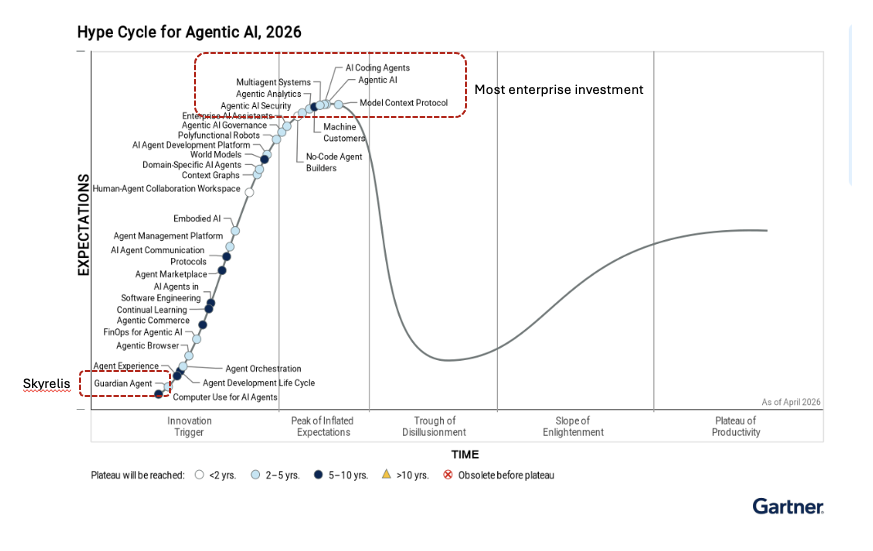
Most enterprise investment right now is concentrated at the Peak of Inflated Expectations — AI agent development platforms, multiagent orchestration, automation tooling. That's where the demos are, the vendor noise, and most of the $3.6B in 2026 funding.
Agentic AI Security and Guardian Agents are still in the Innovation Trigger phase. That's not a weakness — it's a timing advantage. The enterprises that build governance infrastructure now, before the wave of agent deployments crashes into the security stack, will be the ones that don't face a crisis at the trough.
Gartner specifically flags this in their governance hard truth: "You can't bolt governance on after the fact." As agents gain access to more systems, make more decisions, and operate with greater autonomy, the blast radius of a poorly governed deployment grows. The time to build the governance layer is before you need it, not after an incident forces the conversation.
What This Means for Your Security Team, Specifically
Gartner's framework translates into five concrete actions:
- →Inventory every agent in your environment — sanctioned and unsanctioned. Most enterprises are missing 70–80% of their actual agent footprint.
- →Classify agents by autonomy level and data sensitivity. A read-only reporting agent and a write-enabled multi-step agent with CRM access are not the same risk profile. They need different controls.
- →Enforce least-privilege at the agent level — per session, not per deployment. What an agent can access should be bounded by the customer context it's operating in.
- →Build agent incident response playbooks now. When an agent exceeds its scope, how long will it take your SOC to detect it? What's the containment procedure?
- →Implement an MCP gateway for governed connectivity. Gartner recommends adopting MCP now — paired with an explicit warning: ungoverned MCP access creates new attack surface. Every MCP connection should be observable and auditable.
If Gartner is right — and the data suggests they are — your agent fleet is your biggest security gap right now. Not ransomware. Not cloud misconfiguration. The agents already running in your production environment.
Find Out Where Your Agent Fleet Stands
Skyrelis's Agentic Readiness Assessment benchmarks your posture across agent inventory, runtime policy, and governance coverage. Ten minutes. A clear picture of where your gaps are — before an agent exposes them for you.
- Gartner Identifies the Top Cybersecurity Trends for 2026 (Feb. 5, 2026)
- Gartner Hype Cycle for Agentic AI 2026 (Apr. 2, 2026)
- Gartner Predicts 40% of Enterprise Apps Will Feature AI Agents by 2026
GARTNER is a registered trademark and service mark of Gartner, Inc. and/or its affiliates in the U.S. and internationally. HYPE CYCLE is a registered trademark of Gartner, Inc. and/or its affiliates. Gartner does not endorse any vendor, product or service depicted in its publications. All Gartner research cited represents the opinions of Gartner's business and technology insights organization.