NIST Just Put a Spotlight on the Real Agentic AI Security Problem
Agents can move data, money, and decisions in seconds. Governance must keep up.
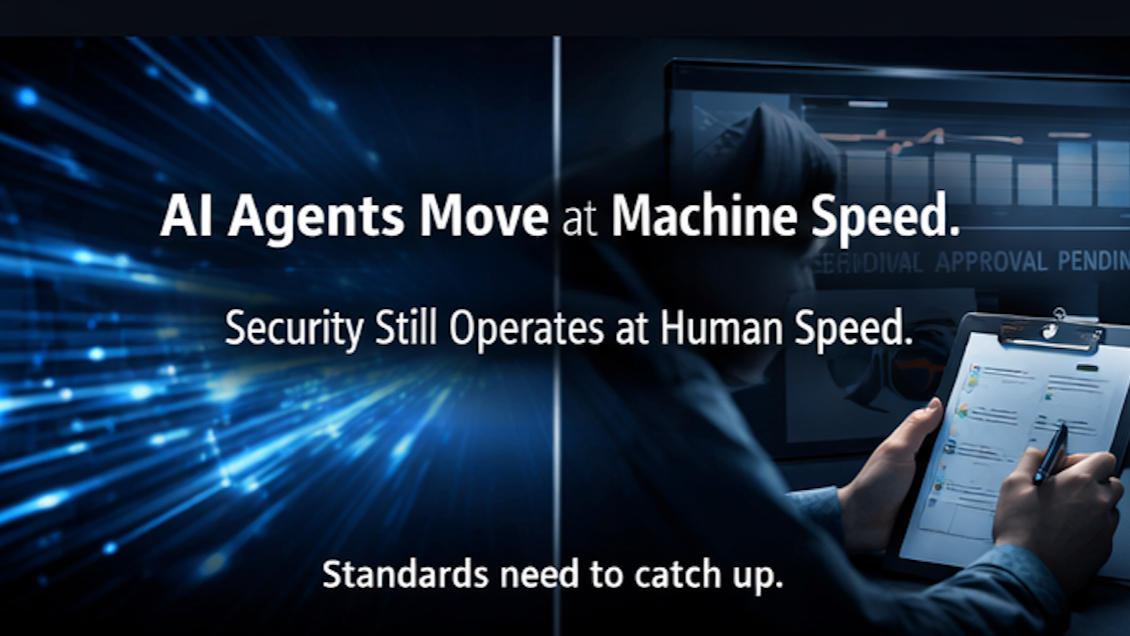
There is a simple reason agentic AI feels different from the AI wave that came before it: agents do not just answer questions. They take actions.
They update patient records. They issue refunds. They reorder supply chains. They touch systems that move your data and your money. Once agents are authorized to act, their blast radius changes fast.
That is why two recent NIST signals matter so much.
On March 9, NIST announced a new report on the monitoring of deployed AI systems. The central message was clear: pre-deployment testing is not enough. Once AI is live in the real world, organizations need ongoing monitoring to validate behavior, catch unforeseen outputs, and understand unexpected consequences in context. NIST's report organizes this challenge into six monitoring categories: functionality, operations, human factors, security, compliance, and large-scale impacts. (nist.gov)
A few days later, on March 19 and 20, NIST hosted a workshop on "Smart Standards." The premise was just as important. NIST said the traditional standards-development process is being challenged by the pace of emerging technologies, including AI, and that standards themselves may need to evolve through the use of AI, model-based standards, and ontologies. In plain English: standards cannot stay static while the systems they govern become dynamic. (nist.gov)
Put those two signals together and the takeaway is hard to miss.
If agents operate at machine speed, they can do damage at machine speed too. Human-speed controls are no longer enough.
The old model was built for software that waited
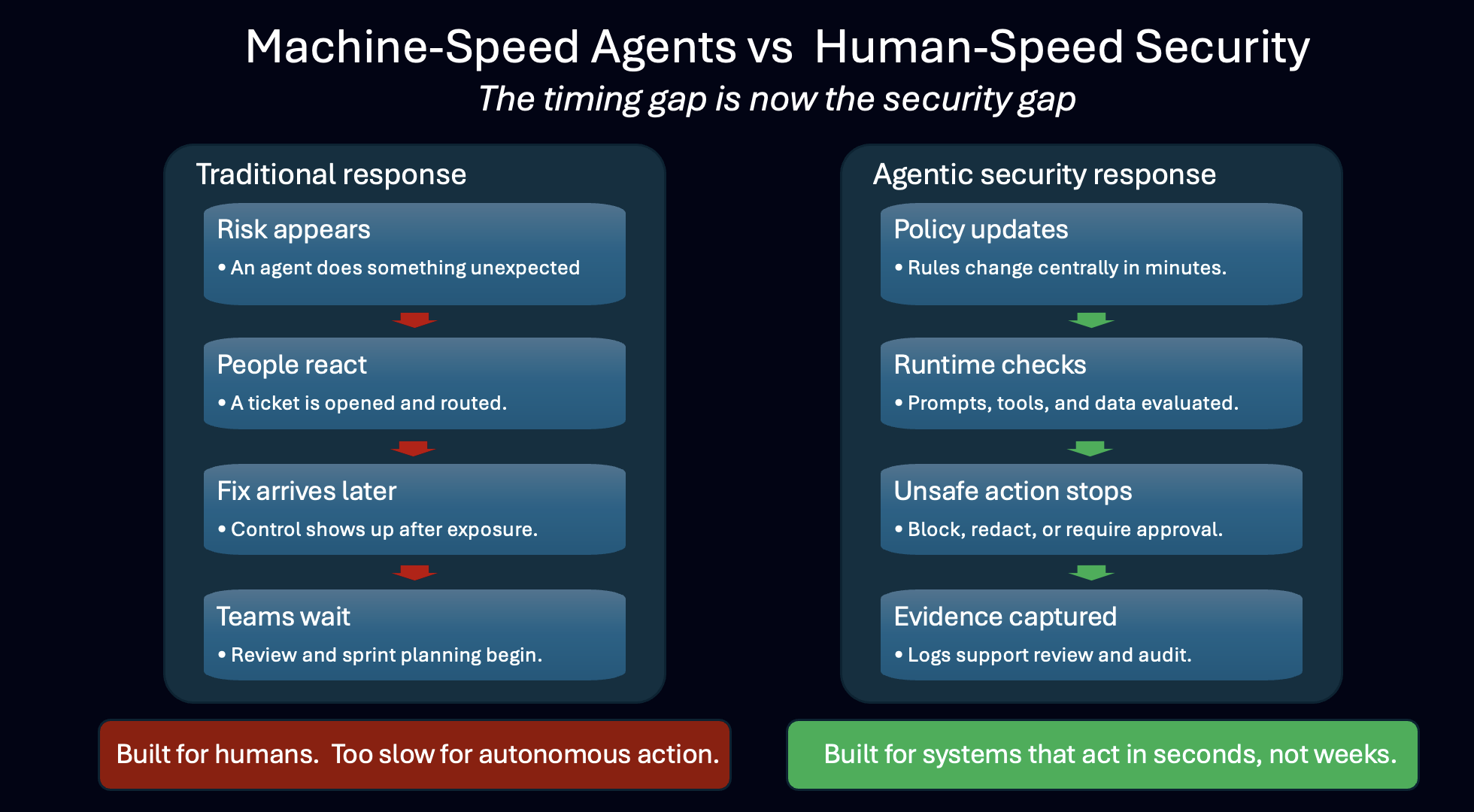
Traditional enterprise controls assume a fairly comfortable sequence. A policy is written. A team interprets it. A developer gets a ticket. A sprint is planned. A control is hard-coded. Security reviews happen later. Audit evidence gets assembled after the fact.
That model may be slow, but for older systems it was usually tolerable.
Agentic systems break that timing. They can chain decisions across tools, APIs, applications, and data stores in seconds. They can take perfectly legitimate permissions and use them in ways no one intended. They can behave differently in production than they did in testing because real environments are messier than controlled evaluations.
NIST's March report lands right on that point. It says post-deployment monitoring is necessary because AI systems are non-deterministic, because real-world conditions vary, and because unexpected consequences only become visible in deployment contexts. That is not a minor technical footnote. It is the beginning of a different security model. (nist.gov)
This is where agentic security becomes a business issue
A lot of AI security discussion still sounds like a model lab problem. It focuses on benchmarks, red-teaming, or prompt filtering in isolation.
Those things matter. But they are not the whole problem.
The moment an agent can take action, the question changes from "Is this model safe?" to "Who is controlling this agent right now?"
That is the question we think matters most.
NIST's report is useful because it does not treat security as a narrow box. It places security next to operational monitoring, compliance monitoring, and human factors monitoring. That is exactly right for agents. An agent can be technically functional and still create risk. It can be compliant on paper and still act in ways that make no operational sense. It can stay online and responsive while quietly doing the wrong thing faster than any human team can react. (nist.gov)
One detail from the report is especially relevant: NIST highlights fragmented logging across distributed infrastructures as a real barrier. That sounds abstract until you think about how agents work in practice. One agent may involve the model, the orchestration layer, the identity layer, the CRM, the ticketing system, the finance app, and a cloud API. If your visibility is fragmented across all of those pieces, your control is fragmented too. (nist.gov)
You cannot secure agentic AI with siloed, human-speed tools built for individual applications. You need an organization-level policy layer with runtime enforcement. One policy. Enforcement everywhere.
Why the standards conversation matters now
The NIST workshop on Smart Standards may sound more academic at first glance, but it is actually very practical.
NIST says standards development itself is under pressure. Technology is changing too quickly. Cross-domain use cases are growing. Static and siloed standards processes are struggling to keep up. That is why the workshop focuses on a more integrated approach that spans text, algorithms, time, and geography. (nist.gov)
That matters because agentic systems do not wait for the next committee cycle.
If standards remain human-speed documents while agents act at machine speed, the gap between policy and reality gets bigger every quarter. In that gap, organizations improvise. Different teams interpret rules differently. Controls become uneven. Monitoring becomes inconsistent. Security becomes reactive.
The future has to look different.
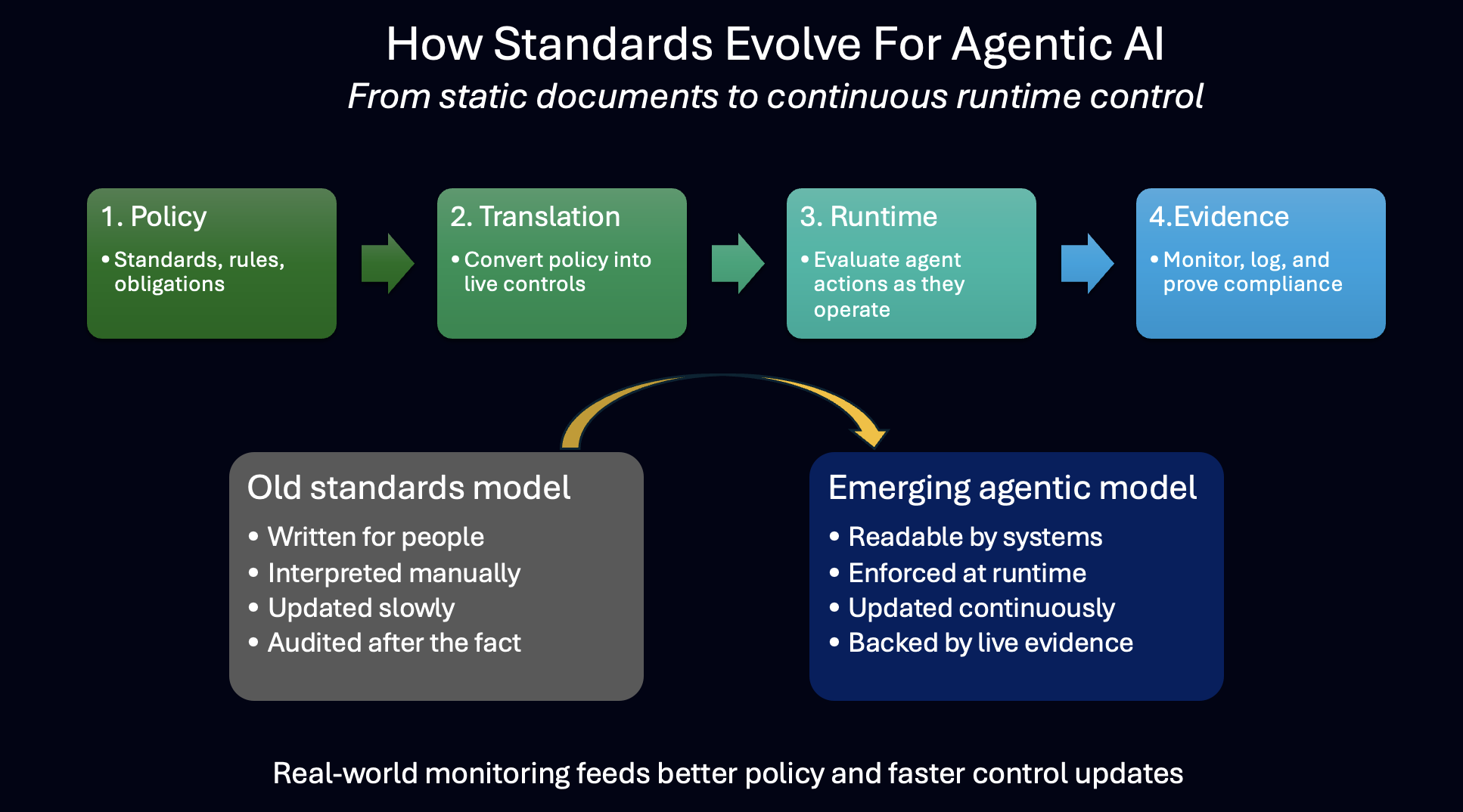
Standards will still matter, but they need to become more operational. More machine-readable. More measurable. More testable in real environments. More connected to runtime evidence.
That does not mean a world where agents magically "understand compliance." It means a world where policies and standards are translated into live controls that can be monitored, updated, and audited continuously.
That is the bridge between the March 9 report and the later workshop. The report says deployed AI must be monitored in the real world. The workshop suggests standards themselves must evolve to support that world better. (nist.gov)
What this means for Skyrelis
Our view is simple.
Agentic security cannot be treated like a slower version of application security. It needs to match the speed and shape of the thing it is protecting.
If agents can plan, route, execute, and escalate in seconds, then governance also has to operate in seconds. Not after a sprint. Not after a help desk ticket. Not after a monthly audit review.
That is why we focus on runtime enforcement.
The goal is not to make security more bureaucratic. The goal is to make it immediate. Update policy without code changes. Apply it across agents and environments. Block unsafe prompts, restrict tool use, redact risky outputs, require approvals where needed, and create an audit trail while the action is happening — not after the damage is done.
If the old standards model was built for human-speed systems, the next one has to be built for machine-speed systems.
The broader shift
This is bigger than one company, one product, or one conference.
NIST is putting structure around something many teams already feel intuitively: AI risk does not end when a model ships. In many ways, that is where the real challenge starts. (nist.gov)
And standards bodies are signaling something equally important: governance cannot remain frozen while AI systems become more autonomous, more connected, and more embedded in daily operations. (nist.gov)
That is why we think the next era of AI security will be defined less by static guardrails and more by live control. Less by point fixes and more by policy layers. Less by human-speed response and more by machine-speed enforcement.
Because agents do not wait. And neither should the controls that govern them.